Skills and connectors as a company asset: content, protection and governance
The procedures written for agents describe how a company works in unprecedented detail, and they sit in a handful of text files. What they contain, how they are protected and who governs them.
In short. With models increasingly similar and replaceable, the behaviour of an agent system depends on the instructions it receives, today gathered into skills that are portable across platforms. A well-made skill contains steps, acceptance criteria, exceptions and mistakes to avoid, in other words the company's working method. That content can be protected as a trade secret only if the company takes measures to keep it confidential. What is needed is a repository with versions and owners, clear clauses with suppliers and, before anything else, an inventory.
For two years the discussion about competitive advantage in artificial intelligence was about models. Which to choose, whether to train your own, how much to invest in fine-tuning. Meanwhile general-purpose models have become more alike and easier to replace, and people who work with agents every day have noticed that a system's behaviour depends less and less on the model driving it and more and more on the instructions it receives.
Those instructions now have a recognisable form. They are called skills, and they are folders containing a written procedure, any scripts that go with it and the reference documents, which an agent loads when it has to carry out a given task. Around skills are the connectors, which give the agent access to company systems. An organisation that has put agents into its work finds itself, within a few months, with dozens of these objects, and written inside them is how that organisation works.
From the model to the instructions
Adoption has been fast. Anthropic introduced skills in October 2025, published the format as an open standard in December of the same year, and on 22 October 2026 donated it to the Agentic AI Foundation, the Linux Foundation body that already hosts the MCP protocol. In the announcement the company speaks of one million published skills, almost 280 million installations and more than seventy platforms that have integrated the format, including those of its main competitors; these are its own figures, not verified by third parties.
For a company the fact that matters is portability. A well-written skill works with different models and on different platforms, and that moves the value. The model becomes a component that can be changed, as we wrote when discussing how to choose a model for a task, while the codified procedure stays and accumulates.
Those who sell professional services understood this quickly. A firm that modernises applications, a practice that drafts contracts, an agency that produces content have always had a method, kept partly in manuals and largely in people's heads. Today that method is being written in a form a machine executes, and for that reason it is more complete and more precise than it has ever been.
What a skill contains
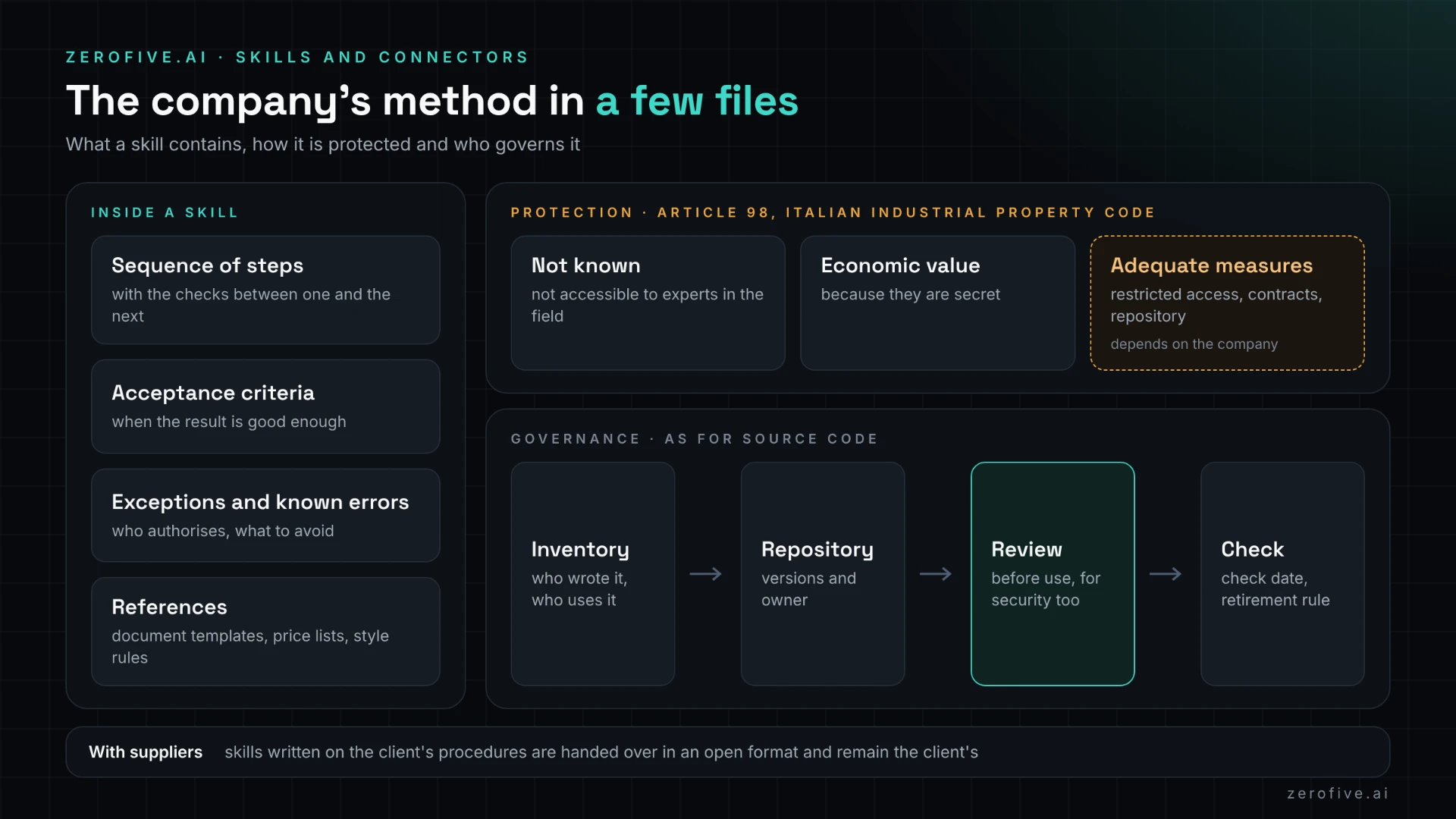
Open a well-made skill and you find much more than a prompt. There is the sequence of steps, with the checks to make between one and the next. There are the criteria for judging whether the result is acceptable, the mistakes to avoid with examples of when they were made, the exceptions and who authorises them. Often there are document templates, price lists, style rules.
Much of this information had never been written down anywhere. It emerges when someone tries to have an agent carry out the task and discovers that the obvious instructions are not enough, so the final skill is the result of dozens of corrections. We described how one is written and constrained in skills and agentic planning.
The result is a document that describes the company's way of working in a level of detail no quality manual has ever reached. It is an asset, and it is also a very easy object to copy, because it sits in a handful of text files.
Legal protection
The law offers protection for this kind of knowledge, on certain conditions. In Italy the Industrial Property Code, at Article 98 as amended by Legislative Decree 63/2018, protects as trade secrets business information and technical know-how that is not generally known or readily accessible to experts in the field, that has economic value precisely because it is secret, and that is subject to measures reasonably adequate to keep it so. Directive (EU) 2016/943 takes the same approach.
The third requirement is the one of interest here. A procedure that circulates without restriction among all employees, is uploaded to personal tools and shared with suppliers for convenience will be hard to defend as a secret. Protection depends on the company's conduct even before it depends on the content.
Practical questions follow that few have asked themselves. Where the skills are stored and who can read them. What the contract with the consultant who helped write them provides. Which skills a collaborator takes with them when they leave the company, given that they often have them on their own computer. Whether the platform provider can access the content, and whether it uses it to improve its own products.
Which framework does your company actually need?
AI Rating measures maturity across the four areas of the model and shows where to start, with priorities and estimated effort.
Start your AI RatingGoverning skills
Treating skills as an asset means applying to them the same discipline that applies to source code. It takes a single repository with version control, an owner for each skill, a review before a change comes into use, and a record of who approved it.
The review also has a security function. A skill is a set of instructions an agent executes with the permissions it holds, and a skill downloaded from a public catalogue may contain instructions nobody in the company has read. Security firms have begun publishing analyses of malicious skills, and the prudent rule is the same as for any third-party software: install only what comes from known sources and has been examined by someone.
Then there is quality over time. A procedure written six months ago on a superseded price list goes on being diligently executed by the agent, which has no way of knowing it has changed. Every skill should have a verification date and a criterion for being retired.
Skills and the relationship with suppliers
When an AI project is entrusted to a supplier, part of the result is the skills and connectors built for the client. The contracts we see rarely say who they belong to, and the matter surfaces at the end of the relationship, when the company discovers that the system only works inside the supplier's environment.
It is best clarified at the start, together with the other exit conditions we described in the piece on vendor lock-in. Skills written for a client, with its procedures, should be delivered in an open format and remain its property. The supplier keeps its own general method, which is what sets it apart, and the boundary between the two should be written down.
It works in the opposite direction too. A company buying a service is buying, in part, access to the skills of whoever delivers it, and when assessing the offer it makes sense to ask how much of that method is codified and maintained and how much depends on the individuals assigned to the project. Among the questions to ask before signing, listed in what an AI consulting project delivers, this has become one of the most useful.
The inventory as a starting point
The first step is knowing what you have. In many organisations skills grew from the bottom up, written by individual colleagues for their own work, and nobody has a list. An inventory gathers them, indicates for each who wrote it and who uses it, and separates those containing confidential knowledge from the generic ones.
The other decisions follow from the inventory: which skills become company standards, which should be protected with restricted access, which should be retired because they duplicate or contradict others. It is work that resembles the census of AI systems, and it is worth keeping linked to the register the rules already require.
In the AI Rating we look at this asset in the Delivery dimension, because an organisation with versioned and governed skills takes a use case to production in much less time, and in the Risk dimension for what concerns access and provenance. To work out how to set up the inventory you can start an AI Rating or book an assessment meeting.