Private AI and sovereign AI: the layers of control in a system
Private says who has access, sovereign says who decides on each layer. Six layers to examine, two deployment modes and a sheet for knowing which risk was accepted and by whom.
In short. Private and sovereign denote different guarantees: the first concerns who may access the system and the data, the second who has the final say on each layer that makes it up. A deployment in a dedicated cloud is private and remains subject to the provider's decisions and jurisdiction. Access to the model is a layer too, as the suspension of two frontier models in June 2026 showed. The aim is to match the level of control to the data class and to know who approved the residual risk.
In conversations with clients the words private and sovereign, applied to artificial intelligence, are almost always used as synonyms. One vendor offers a dedicated instance in a European data centre and calls it sovereign AI, another installs an open model on a client's server and calls it private AI, and whoever has to approve the spend is left with the impression that this is the same guarantee under two names.
The two words describe different things, because private indicates who may access the system and the data it processes, while sovereign indicates who has the final say on each of the layers that make it up, including those the company does not see. A system can be entirely private and depend, in order to keep working, on decisions taken elsewhere, and the difference usually surfaces at the least convenient moment.
The layers of an AI system
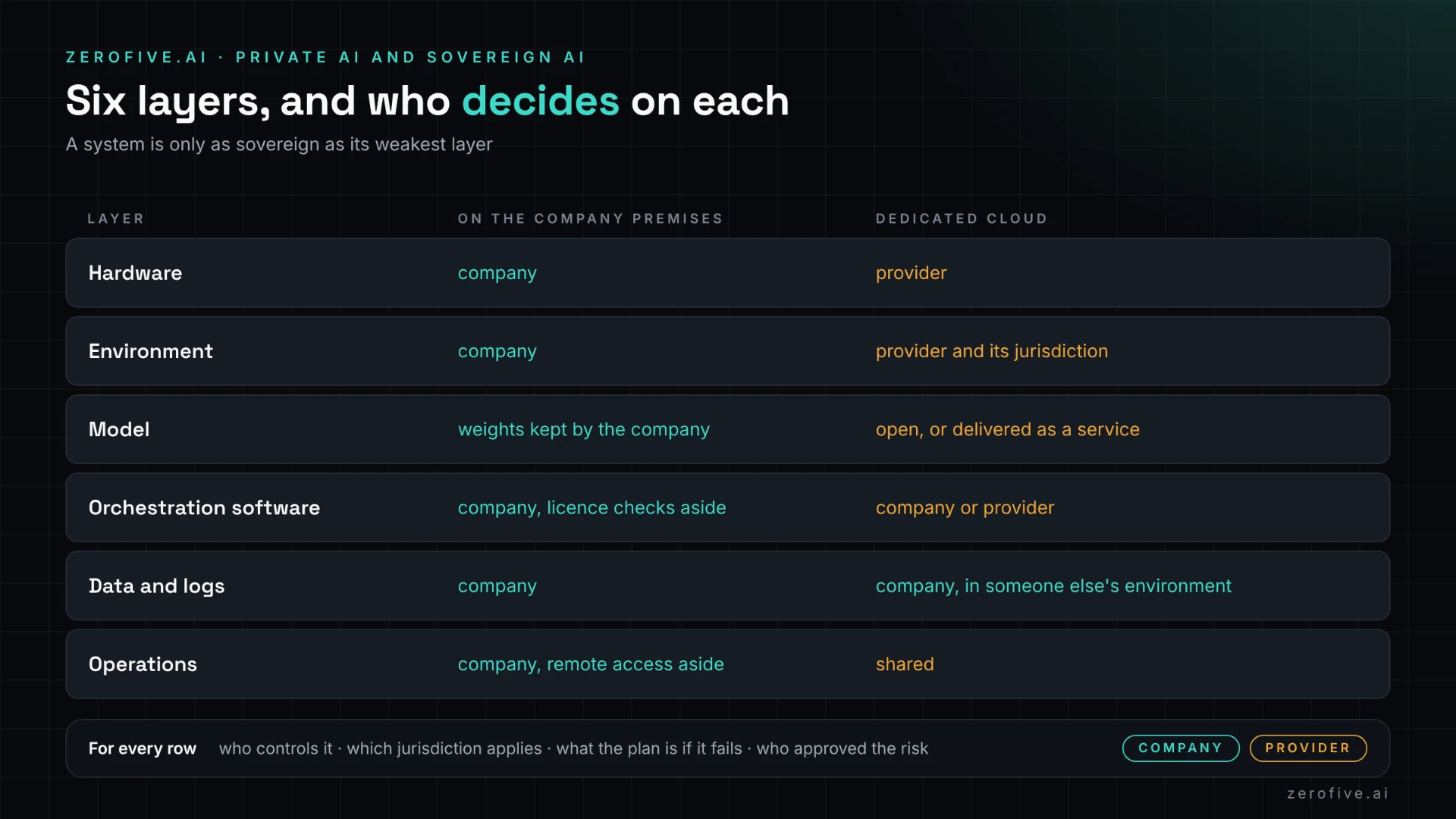
To understand how much control you have, it helps to break the system down and ask, layer by layer, who decides. We use six in our assessments.
- The hardware, meaning graphics processors and servers, and who owns it.
- The environment it runs in, which may be company premises, a rented data centre or a cloud provider's region.
- The model, with its licence and with or without the possibility of keeping a copy.
- The software that orchestrates requests, agents and connectors.
- The data, both what is sent to the model and the logs of what it answered.
- Operations, that is, who installs updates and who can get in for maintenance.
On each layer the answer may be the company, a provider subject to European law, or a provider subject to the law of another country. A system is as sovereign as its weakest layer, and knowing this does not oblige you to bring everything in-house; it obliges you to know which layer you have chosen not to control and what happens if it fails.
The two deployment modes
Simplifying, the architectures offered to Italian companies fall into two families. In the first the infrastructure is physically on the client's premises, sized for the expected workloads, with open models whose weights the company keeps. Every layer is governed by the organisation, which in exchange takes on the initial investment, the risk of having got the sizing wrong and the need to have, or to buy, the skills to run it.
In the second the system runs in a cloud environment reserved for the client. The data is not shared with others, capacity grows when needed and the cost is spread over time, but hardware and environment remain the provider's, which decides on their availability and answers to the authorities of its own country.
Neither is better in absolute terms, and many organisations end up using both for different data classes. The comparison between the options is covered in full in on-premise, cloud or API, while the criteria for choosing between open and proprietary models are in proprietary or open-source LLMs.
The provider's jurisdiction
The place where data is processed and the law that applies to whoever processes it are two separate pieces of information, and the second is the one most often missing from technical sheets. The US CLOUD Act of 2018 allows that country's authorities to ask a provider under their jurisdiction for the data it controls, regardless of where it is stored. We looked at it in detail when discussing the EU Data Boundary.
The CLOUD Act is the most cited example and it is not the only one. Every provider brings with it the rules of the country where it is based, and a company operating in several markets may find itself having to meet localisation obligations that change from one to the next. The choice of environment therefore also changes the compliance work, starting with the clauses on returning data at the end of the contract.
Neither the GDPR nor NIS2 requires, as a general rule, that data be processed in Italy. Keeping certain data inside a national perimeter is a risk decision the company takes and justifies, as we wrote in protecting data when using AI.
Which framework does your company actually need?
AI Rating measures maturity across the four areas of the model and shows where to start, with priorities and estimated effort.
Start your AI RatingAccess to the model over time
There is a layer few people thought about until recently, and it is the availability of the model over time. On 12 June 2026 Anthropic received an export control directive from the US government barring foreign nationals from access to two of its models, and in order to comply it disabled them for all customers, as the company's statement explains. Access returned on 1 July, after the measure was lifted, and for almost three weeks anyone who had built a process on those models had to fall back on something else.
The episode says nothing about the quality of that provider and a good deal about the nature of the relationship. Access to a model delivered as a service is a concession that can be altered by parties outside the contract, and the environment the model runs in, however private, does not change that fact.
An open model whose weights the company keeps cannot be withdrawn: it may age, and it will be less capable than frontier models, yet a year from now it will do exactly what it does today. For processes where continuity counts for more than peak performance this is an argument with weight, and one to set alongside those on vendor lock-in.
Operational control
Even a system installed in-house can have layers the company does not govern. The vendor that connects remotely for maintenance, the software component that checks the licence by contacting an external service, the automatic update that replaces a model with the next version without anyone having repeated the tests.
These are details that pass quickly in a technical evaluation and that, in an inspection or a dispute, become the substance. The controls we ask for always include a log of all outbound communications from the system, because a deployment declared isolated that opens connections to the outside is more common than people think, and is often the result of a default configuration nobody reviewed.
The same log is useful in the opposite case, when the company decides to place a more powerful external model alongside the internal ones for certain activities. The decision is legitimate provided it is known which requests leave, with what data and to which destination.
A sheet for every system
The tool we propose is a table with one row per layer. For each you note who controls it, which jurisdiction it is subject to and what plan exists if that party fails or changes the terms. Filling it in takes a couple of hours with the vendor, and it is rare for every box to have an answer at the first attempt.
The sheet is not meant to achieve complete sovereignty, which for most organisations would be a waste. It is meant to match the level of control to the data class and to the criticality of the process. An assistant for drafting marketing copy can comfortably depend on an external service, while a system that processes health data or trade secrets deserves a row filled in with far more care.
With the sheet in hand the conversation in the boardroom changes too. Asking whether the company's AI is secure produces a generic reassurance. Asking which layers are not under control, and who approved that risk, produces a name and a date.
In the AI Rating these checks sit in the Risk dimension, and in our gated path they are closed before authorisation to release. To fill in the sheet for your systems you can book an assessment meeting or write to us at hello@zerofive.ai.