AI Company OS
Method, platform and guidance to bring AI into the company's work without losing control of its knowledge.
We design with you the workspace where meetings, email, documents, CRM and conversations with AI become a shared memory. We do it with a six-layer method and with the Workspace, the platform we use every day on our own projects, accessible to people and to AI models.
30 min - No commitment - NDA available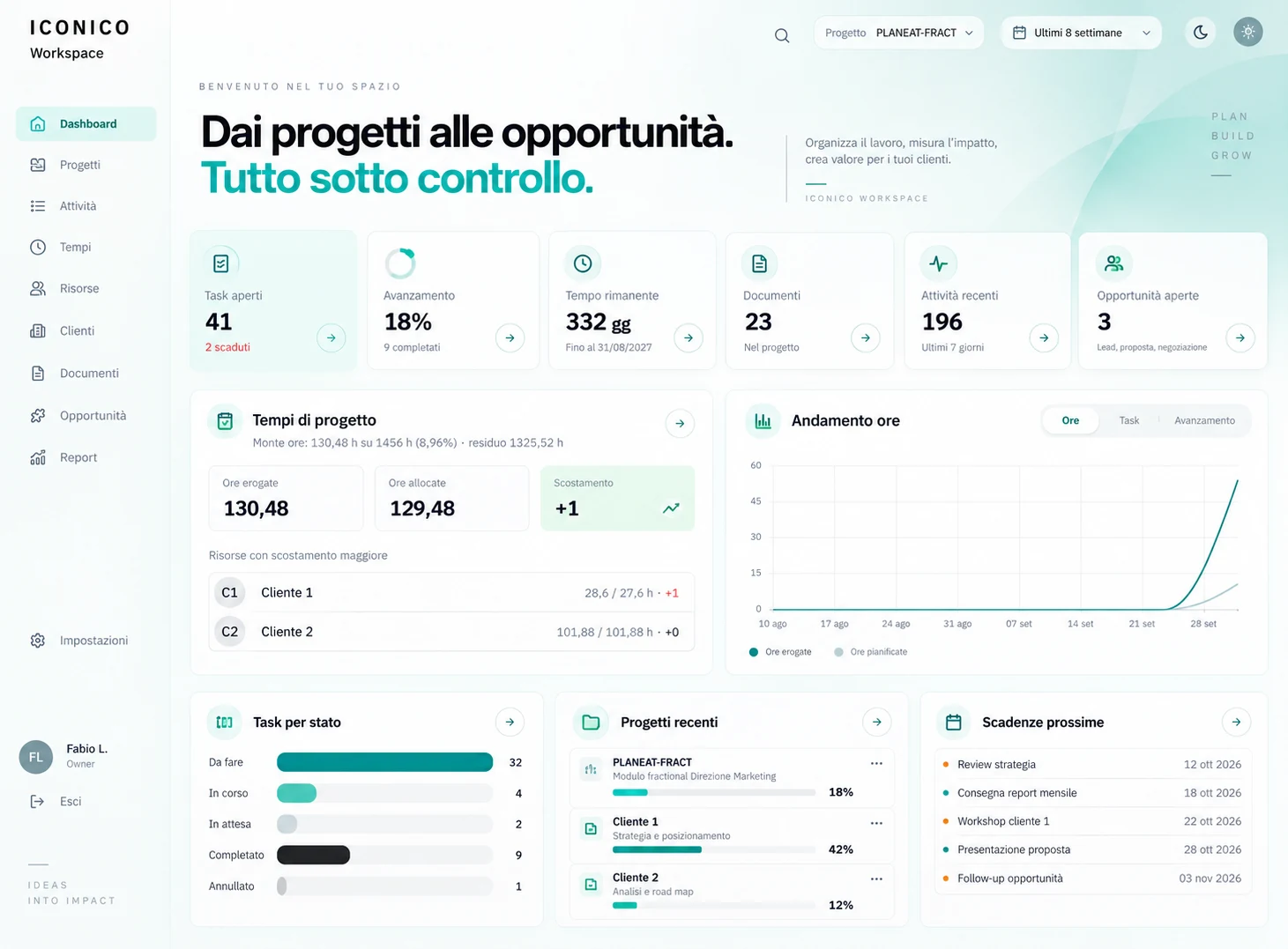
The vision
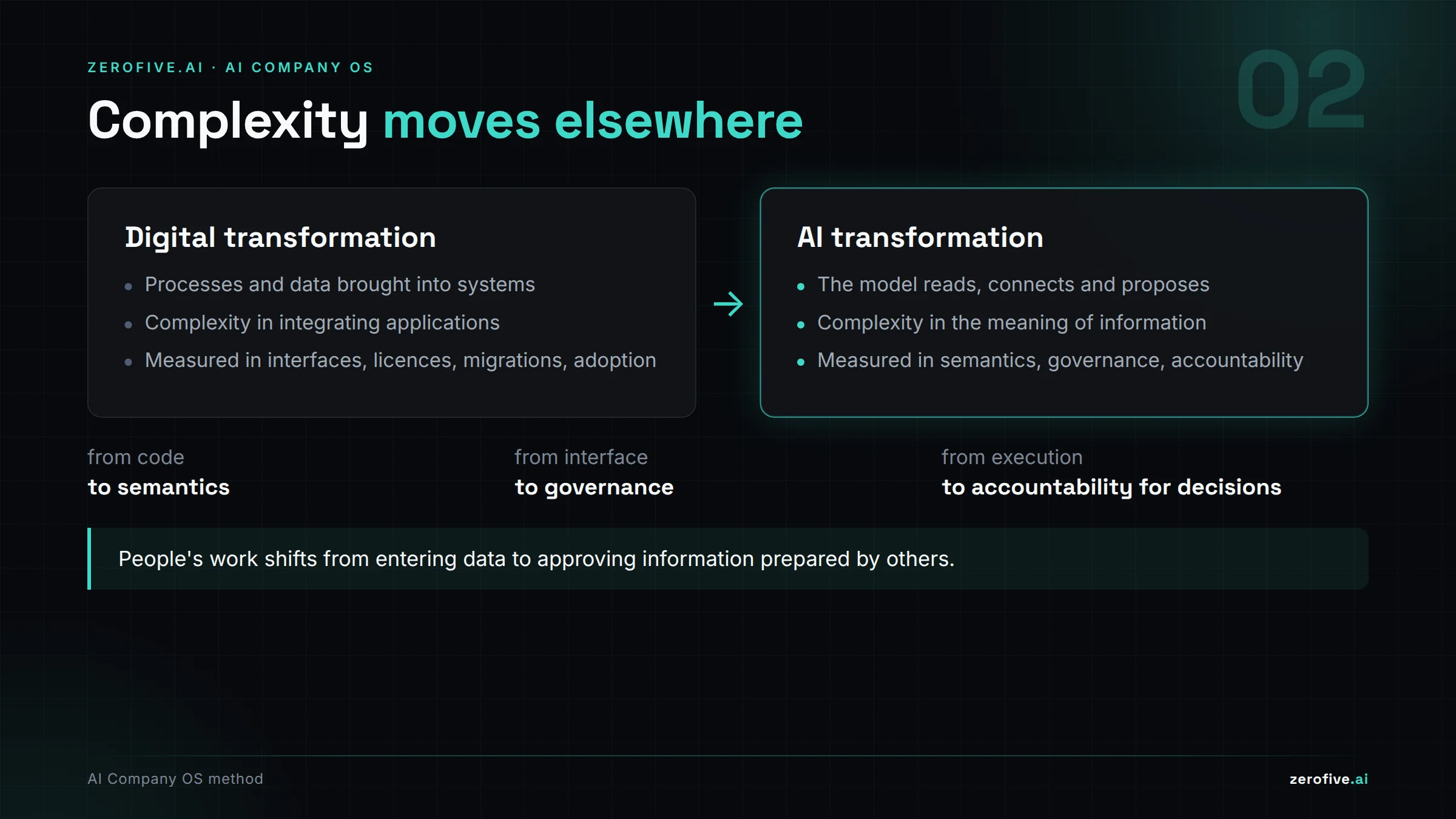
Digital transformation brought processes and data into systems, and its complexity lay in integrating applications. With AI the tools are already there and so are the connectors: an assistant reads email and documents within minutes. Complexity moves to the meaning of information and to who is entitled to confirm it.
This is why we believe an AI-ready company is not the one with the most powerful model, but the one that has decided what its information means, who owns it and who approves what the model proposes. It is an operating system for knowledge, and the model is chosen last.
Our approach
Five principles that apply to every project, whatever tool is chosen.
The model is chosen last
First you decide where knowledge lives and what it means. The model is a reader that can be replaced without losing anything.
Every data item has one owner
The CRM stays the CRM, the file store stays the file store. The project memory keeps links, not copies.
The model proposes, people approve
Nothing enters the shared memory without a person approving it, with source and confidence stated.
Code verifies what can be verified
Amounts, origins, formats and entry rules are checked by deterministic scripts. The model keeps the work of reading and connecting.
Start from a single team
A limited scope, a named owner, a success criterion stated before launch.
The method in six layers
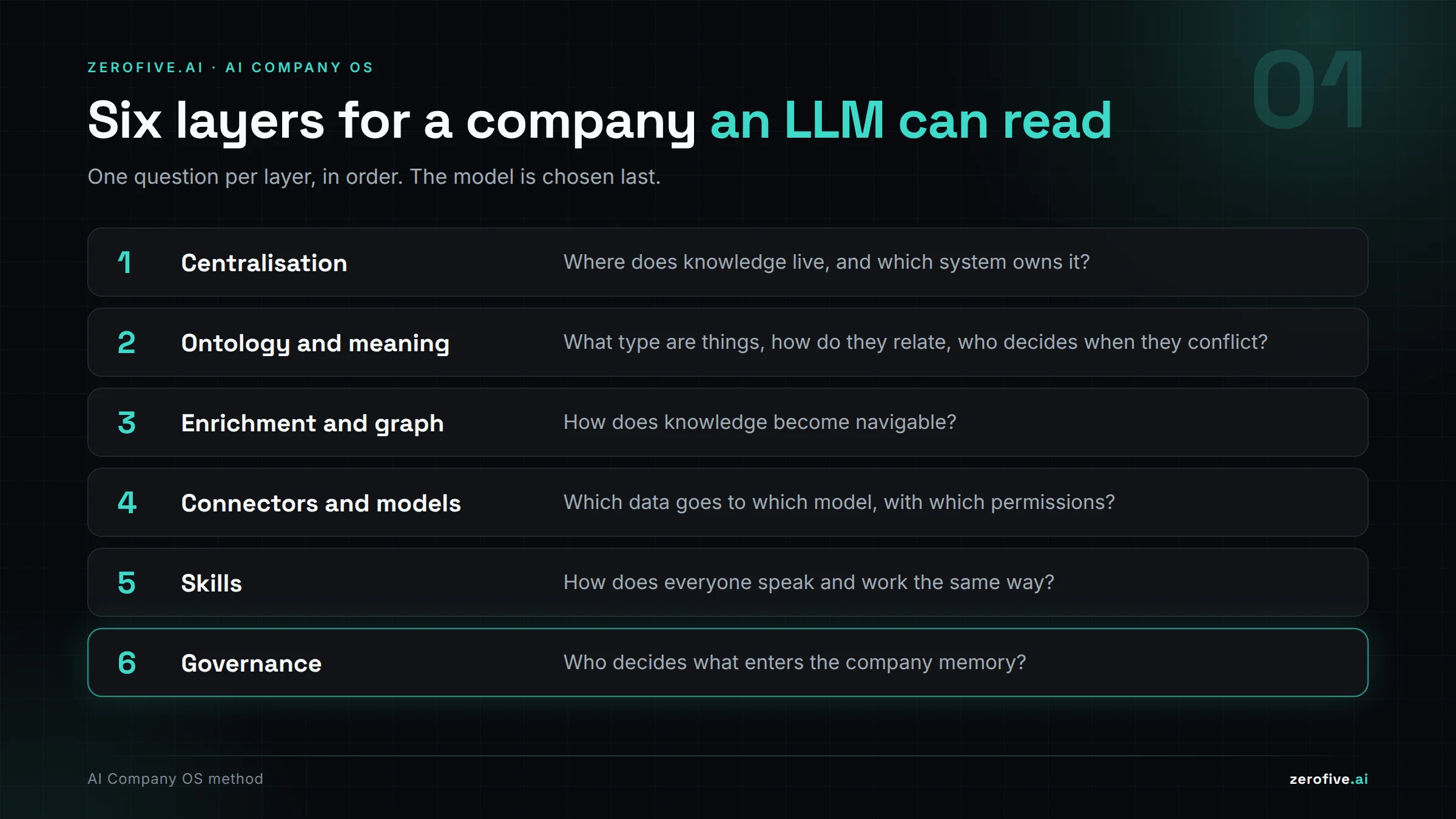
One question per layer, in order.
Centralisation
Where does knowledge live, and which system owns it?
Every piece of information becomes an object with author, date and place in the project. Every data item has a single system of record: the CRM stays the CRM, and the project memory keeps a link.
Ontology and meaning
What type are things, how do they relate, who decides when they conflict?
Object types, typed relations, tag vocabulary, routing rules and exceptions written before the model has to improvise.
Enrichment and graph
How does knowledge become navigable?
Mentions, suggested links to confirm, connections between notes, tasks, documents and hours of work. The question of what we know about a client becomes a path starting from its node.
Connectors and models
Which data goes to which model, with which permissions?
An access server independent of the model, operating with the real permissions of whoever uses it. The model is chosen per data class and replaced without migrations.
Skills
How does everyone speak and work the same way?
Recurring procedures written once, in a single versioned catalogue. Rules live in the skill, data is read from the system, and what can be verified is verified by code.
Governance
Who decides what enters the company memory?
The model prepares proposal packages with source, excerpt and confidence, and a person approves, corrects or rejects them. Every object has an origin and an owner.
The Workspace platform
The method lives in a tool. The Workspace is the platform we built to run our client projects: people use it in the browser, AI models read and update it through an MCP server, always with the permissions of whoever is using them.
Project memory
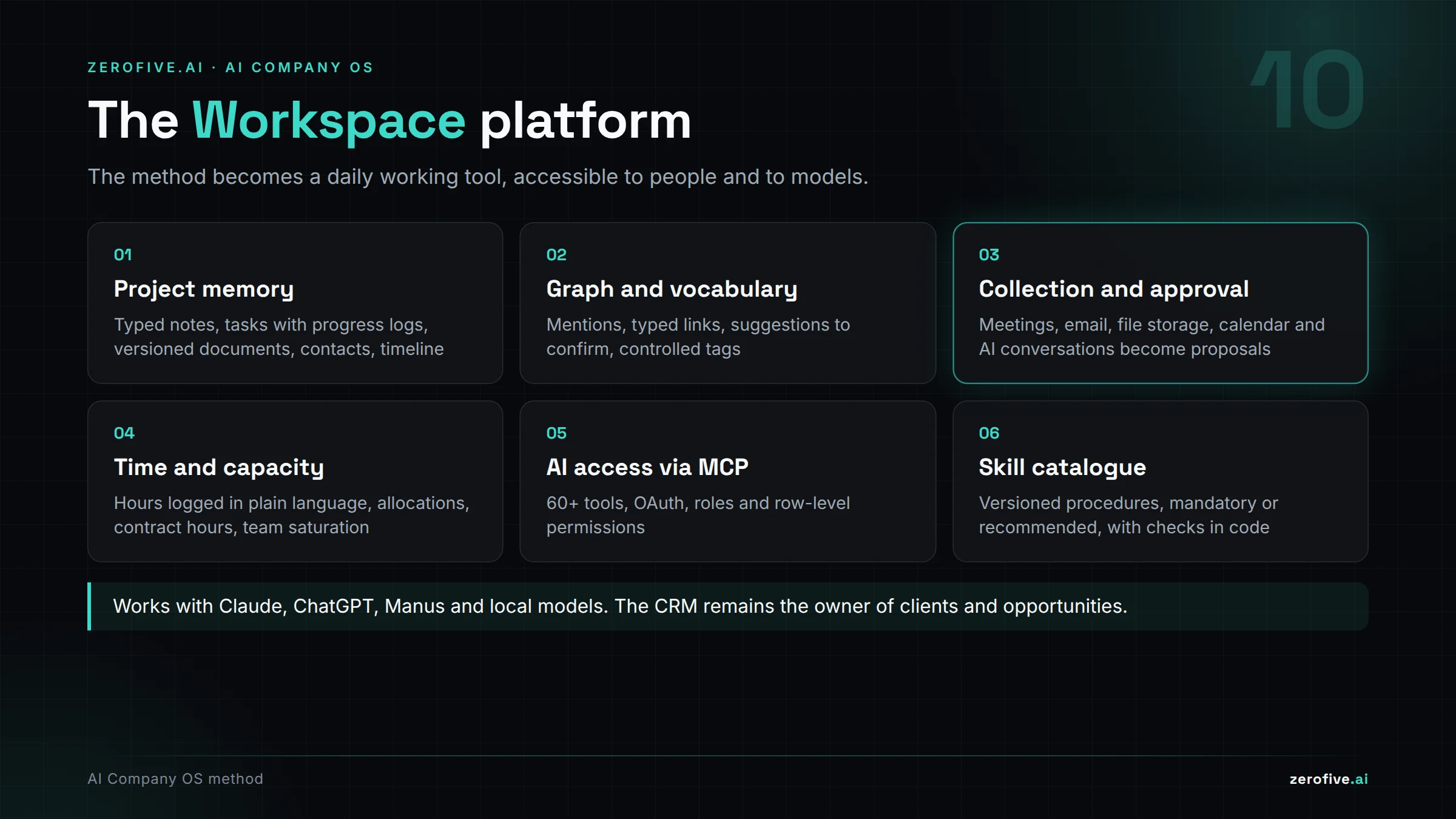
Typed notes (notes, minutes, decisions, risks, insights, feedback, consolidated knowledge), tasks with progress logs, versioned documents with folders and extracted text, contacts with their role, a timeline of who did what.
Graph and vocabulary
@ mentions that become links, typed relations between notes (reference, confirms, integrates, diverges, consolidates), automatic suggestions to confirm, a relationship map up to three steps, normalised tags with similarity checks.
Collection and approval
A scheduled collection reads recorded meetings, email, Drive, Dropbox, calendar and AI conversations, routes by project and prepares proposal packages with source excerpt and confidence. Rejected proposals do not come back.
Time and capacity
Hours logged by writing in plain language, linked to tasks and meetings, weekly allocations, contract hours and team saturation. No financial data: that stays in the administrative systems.
AI access via MCP
More than sixty tools exposed with OAuth authentication, project roles (lead, contributor, viewer, guest) and row-level permissions on every table. Works with Claude, ChatGPT, Manus and clients running local models.
Skill catalogue
Procedures in one current version, mandatory or recommended, with dependencies and required connectors, verified against source fingerprints. Today they cover collection and briefs, documents with style checks and commercial proposals.
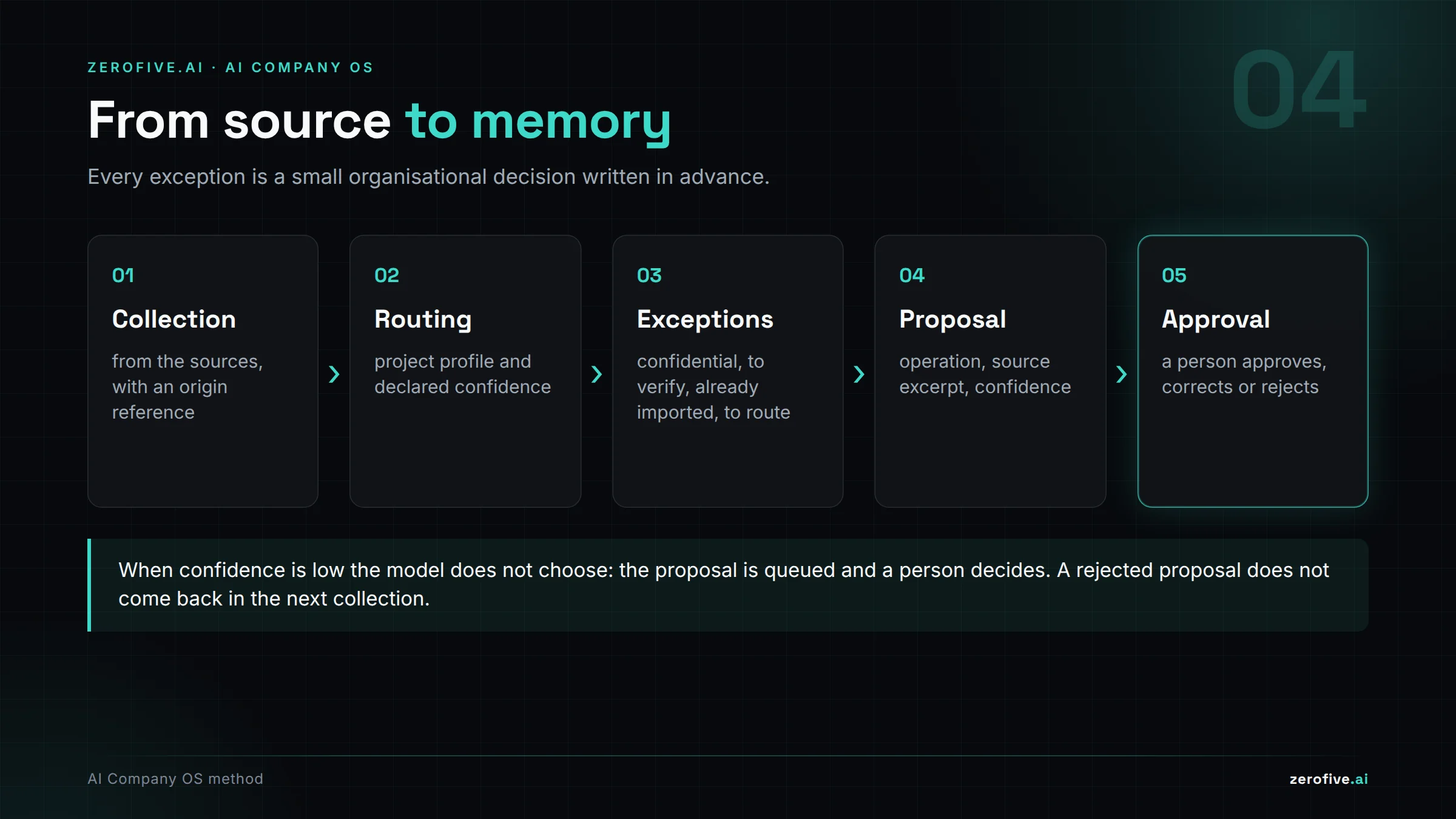
From source to memory
Every piece of information collected carries its origin. The project profile (email domains, acronyms, keywords) decides where it goes, exceptions such as confidential or to verify are rules written in advance, and when confidence is low the decision goes back to a person.
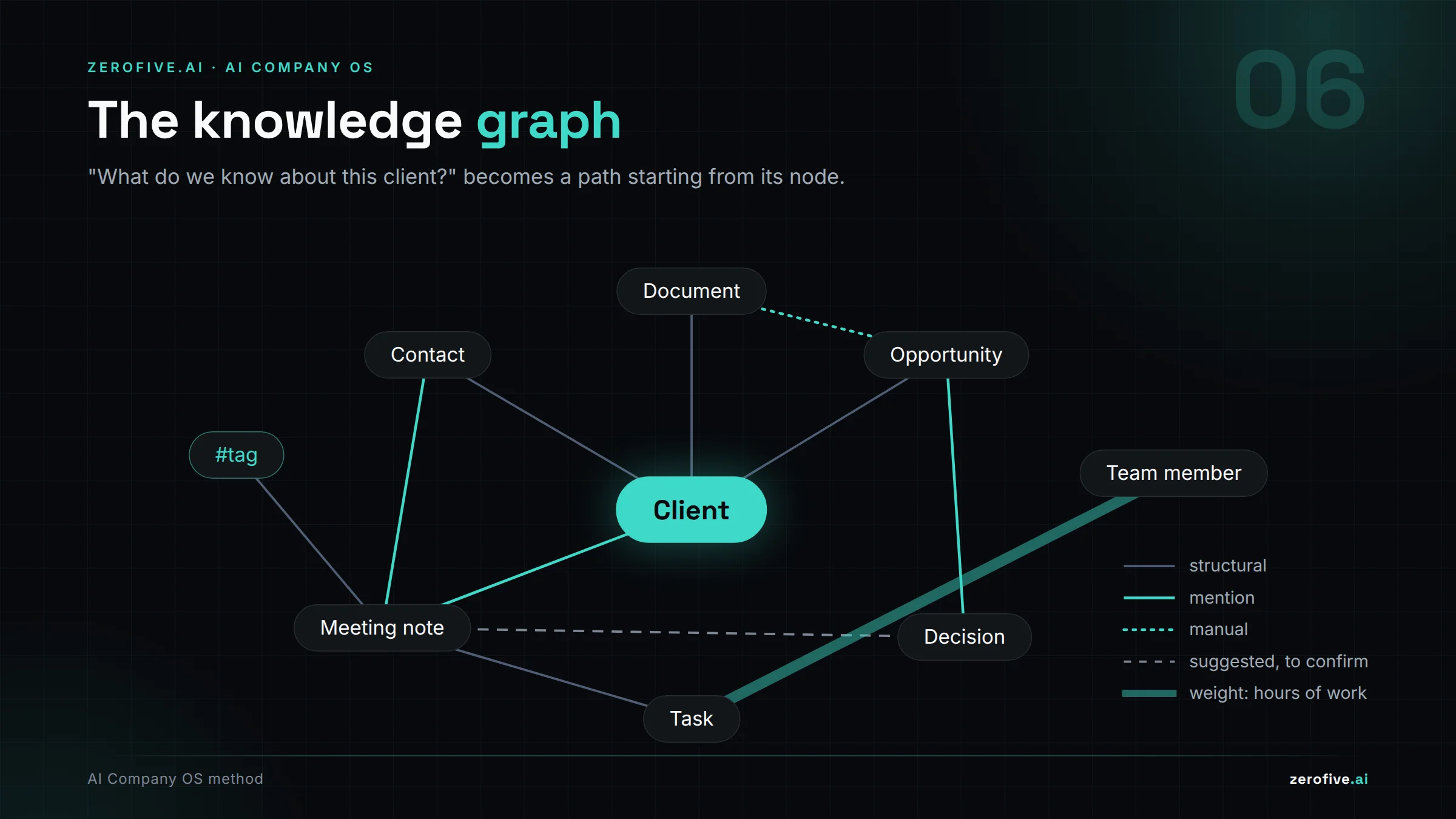
The graph prepares meetings
Before a meeting the model starts from the contact's node and gathers recent notes that mention them, open opportunities, tasks due and conflicts still to close. When two sources contradict each other a verification is opened and assigned to a person.
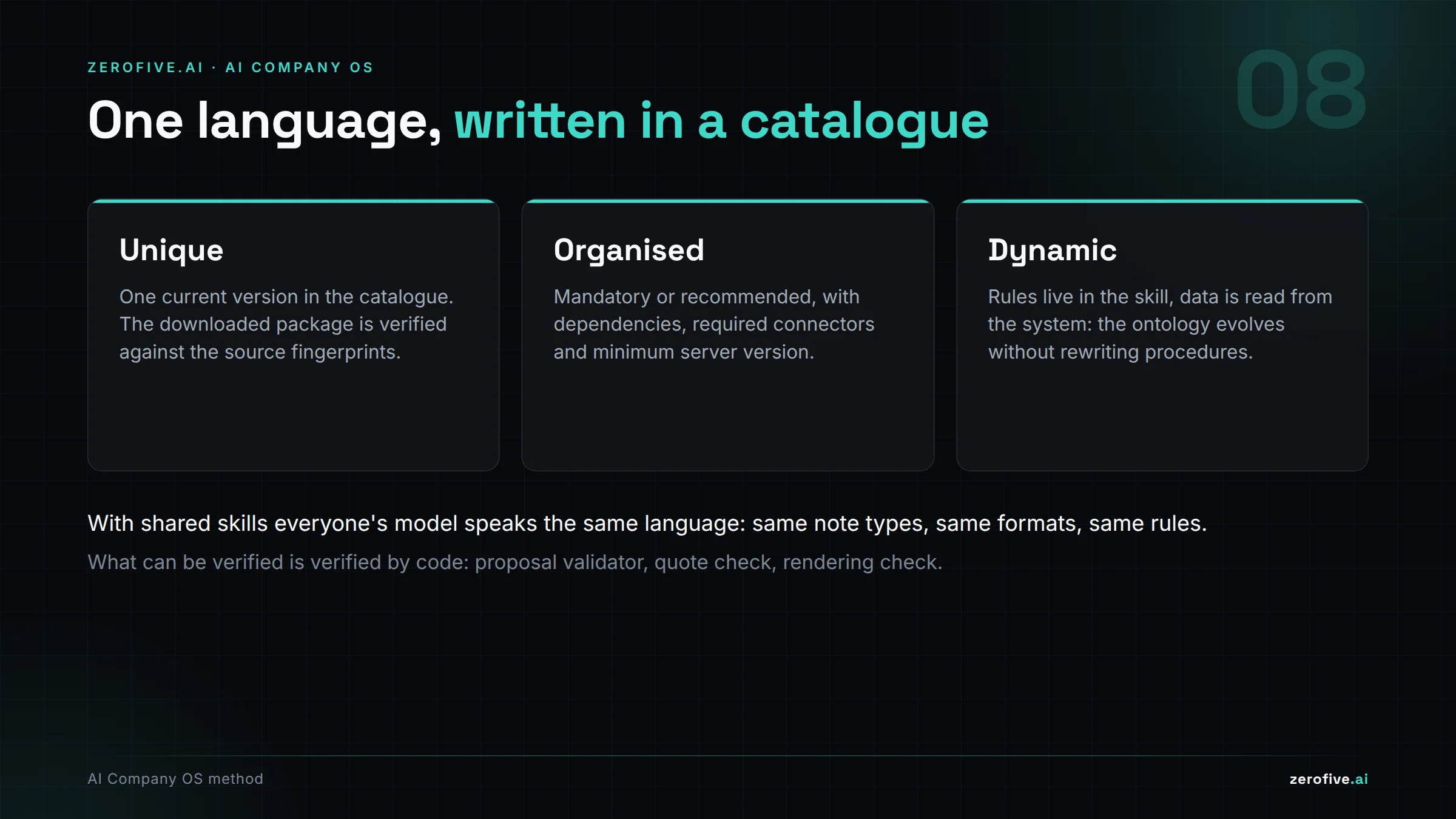
Skills bring the method into every conversation
Anyone on the team using an AI assistant works with the same note types, formats and rules, because procedures come from the catalogue and data is read from the Workspace. When a rule changes a new version is published and everyone receives it.
tables with row-level permissions
tools via MCP server
compatible AI platforms: Claude, ChatGPT, Manus
writes without approval
Want to see it working on a real project?
Book a demoWhich model for which data
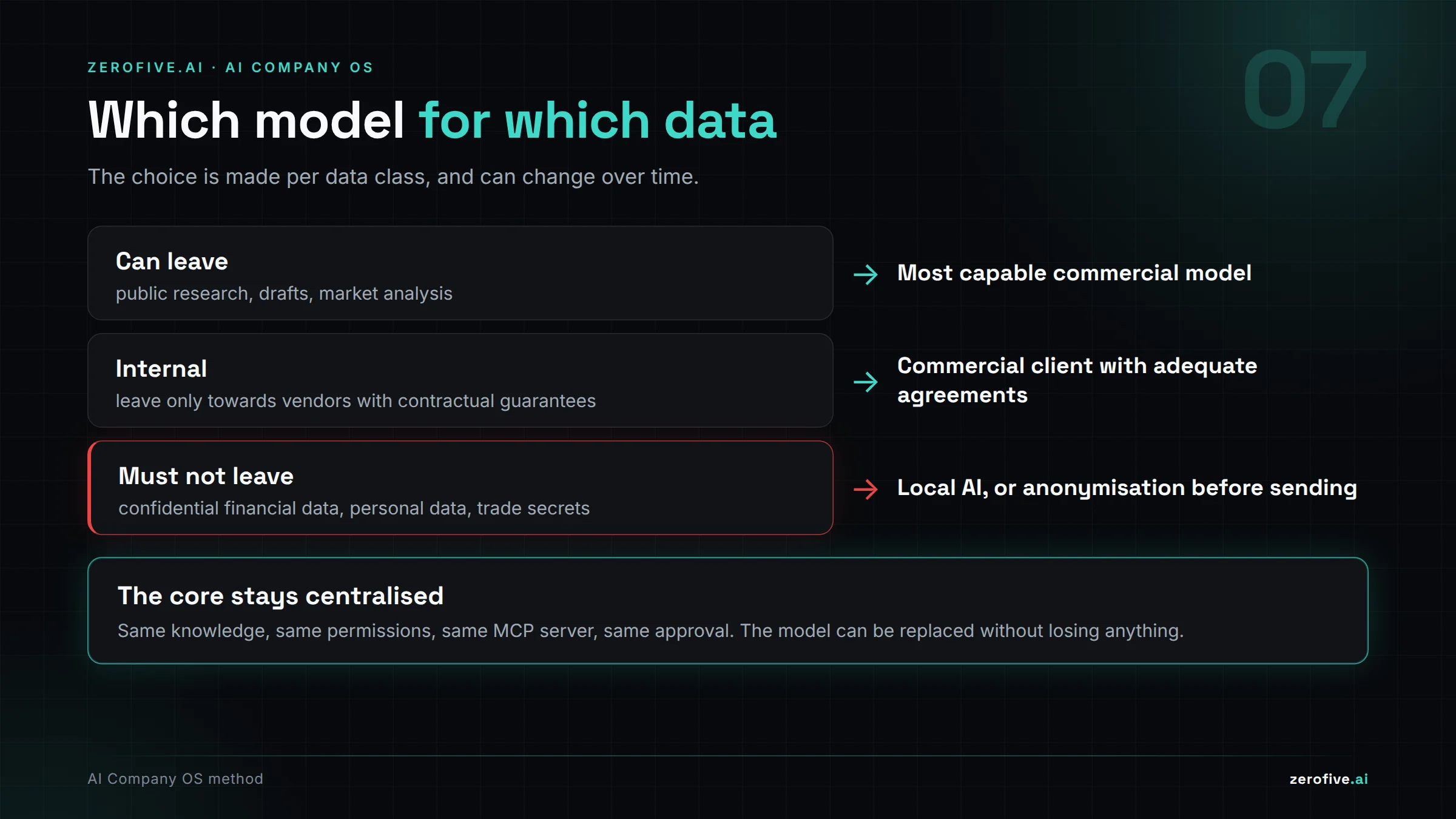
We classify information into three classes. What can leave goes to the most capable commercial model, internal data only to vendors with contractual guarantees, and what must not leave stays on a local model or is anonymised before sending. In the Workspace confidential content is already marked, and that marker becomes the criterion for deciding which client may read it. Changing vendor becomes a decision about cost and confidentiality, with no migrations.
How to adopt it
Same method, three starting points. The choice depends on the tools you have and on who will run the system.
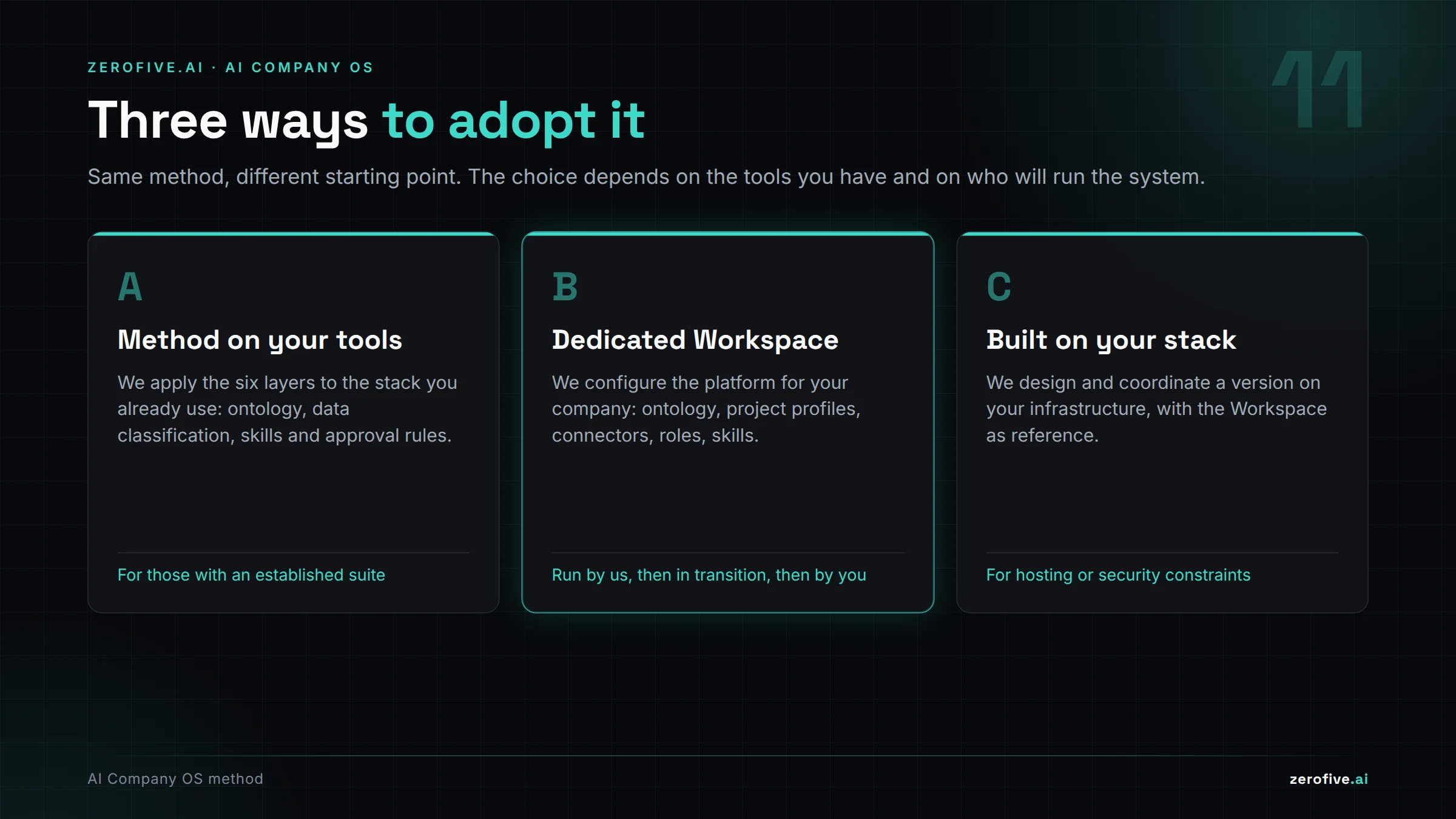
Method on your tools
We apply the six layers to the stack you already use, whether Microsoft 365, Google Workspace or another: ontology, data classification, approval rules and skills for your AI assistants. No new platform.
Suited to: companies with an established suite and a structured IT team
Dedicated Workspace
We configure the Workspace for your company: ontology, project profiles, connectors, roles and skill catalogue. During the pilot we run it, then a transition phase follows with a checklist, and finally you run it.
Suited to: teams that want to start quickly on a proven tool
Built on your stack
We design and coordinate the development of a version on your infrastructure, using the Workspace as an architectural reference, with your IT or developers we coordinate.
Suited to: companies with hosting, security or integration constraints
The path, in every case
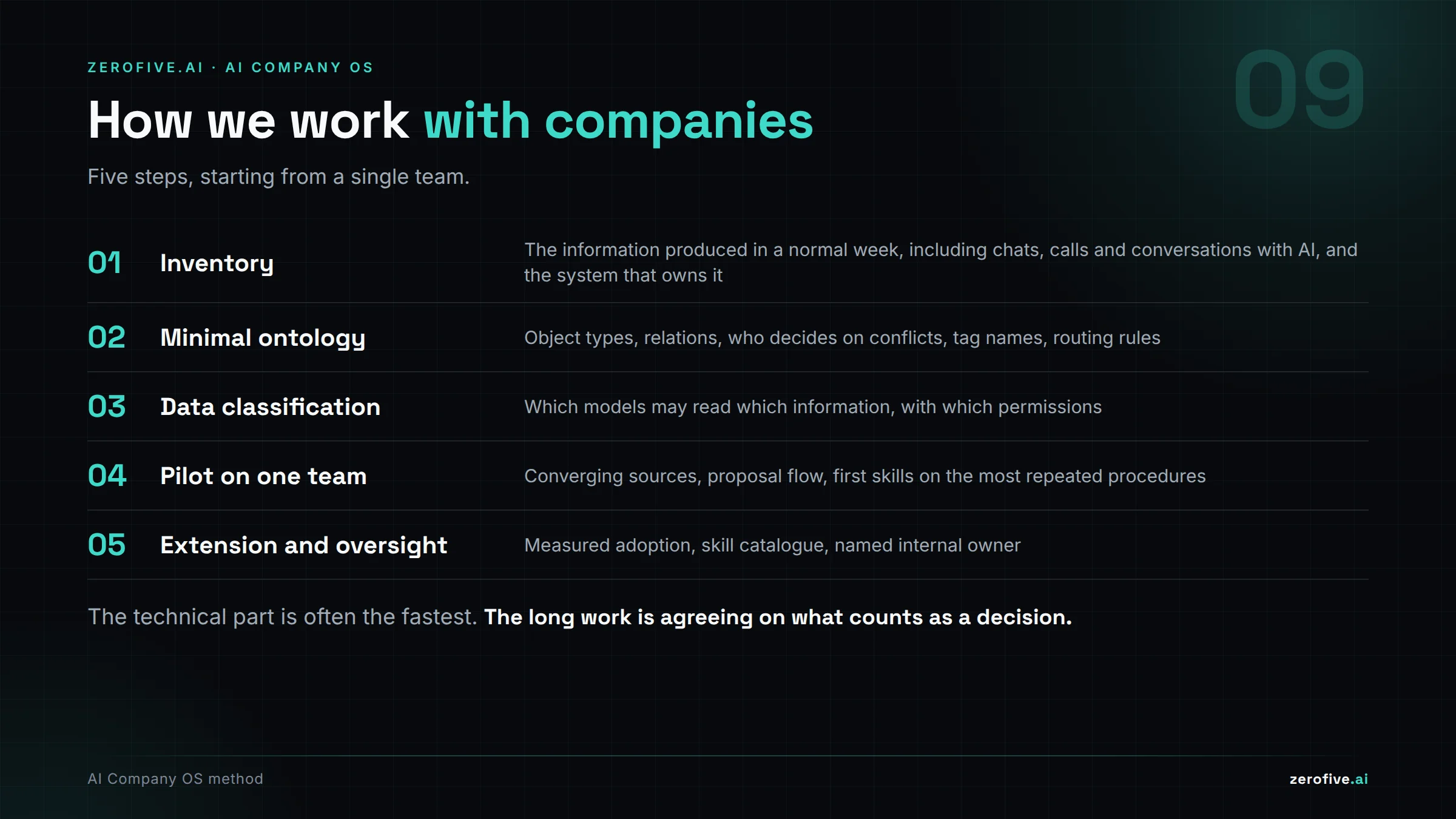
Inventory
We map the information the team produces in a normal week, including chats, calls and conversations with AI, and the system that owns it.
Output: Map of knowledge and systems of record
Minimal ontology
We define object types, relations, tag vocabulary, routing rules and exceptions, and who decides when two sources disagree.
Output: Documented ontology and charter of decisions on knowledge
Data classification
We split information into three classes and decide for each which model may read it, with which permissions and through which access server.
Output: Data and model matrix, access requirements
Pilot on one team
We make the sources converge on a limited scope, activate the proposal flow with approval and write the first skills on the most repeated procedures. The pilot starts with a named owner and a success criterion stated before launch.
Output: System running on the scope, first indicators
Extension and oversight
We measure adoption on real data, meaning approved and rejected proposals, closed conflicts, procedures covered by skills, and decide with you whether and how to extend to other teams.
Output: Extension plan, skill catalogue, internal owner
What we deliver
How it integrates
AI Rating
Measures overall maturity, including the readiness of the data and processes the AI Company OS relies on
Discover AI RatingAI Data
Brings data to the level the use cases require; the AI Company OS gives that data a shared meaning and governance
Discover AI DataAI Agents
Agents work well only on a structured knowledge base with real permissions, which is what the AI Company OS builds
Discover AI AgentsFrequently asked questions
Is the Workspace software you sell?
It is the platform we use on our own projects and make available to clients in path B. We do not resell third-party licences: if you prefer to stay on your tools, we apply the method there (path A) or design a version on your stack (path C).
Which AI assistants does it work with?
With any MCP-compatible client: today Claude, ChatGPT and Manus, as well as clients running local models. Skills follow the Agent Skills standard and the document engine only requires Python.
Do we have to replace CRM, email or file storage?
No. Every data item stays in the system that owns it. The Workspace keeps links and, when an opportunity arises from a project, writes it to the CRM instead of duplicating it.
How do you handle confidential and personal data?
Financial and personal information is marked and stays visible only to those entitled to it, and does not go to external models without contractual guarantees or anonymisation. The framework is aligned with the GDPR; for binding legal opinions we work with qualified partners.
Where do we start?
With an inventory session and a single team. The part that takes longest is agreeing on what counts as a decision and who closes conflicts, and we do it with you.
Does it help with the AI Act and ISO/IEC 42001?
A system where every piece of information has an origin, an author and an approval produces the traceability an AI management system requires. We work on preparation and alignment; certification is issued by accredited bodies.
Let's design your AI Company OS
In 30 minutes we show you the Workspace on a real project and work out together which of the three paths makes sense for your company.
Book a demoor write to hello@zerofive.ai