AI agent identity: delegation, credentials and mandate
Many agents operate with the credentials of whoever configured them, and in the logs they cannot be told apart from that person. What changes with time-limited delegation, verifiable mandates and the European identity wallet.
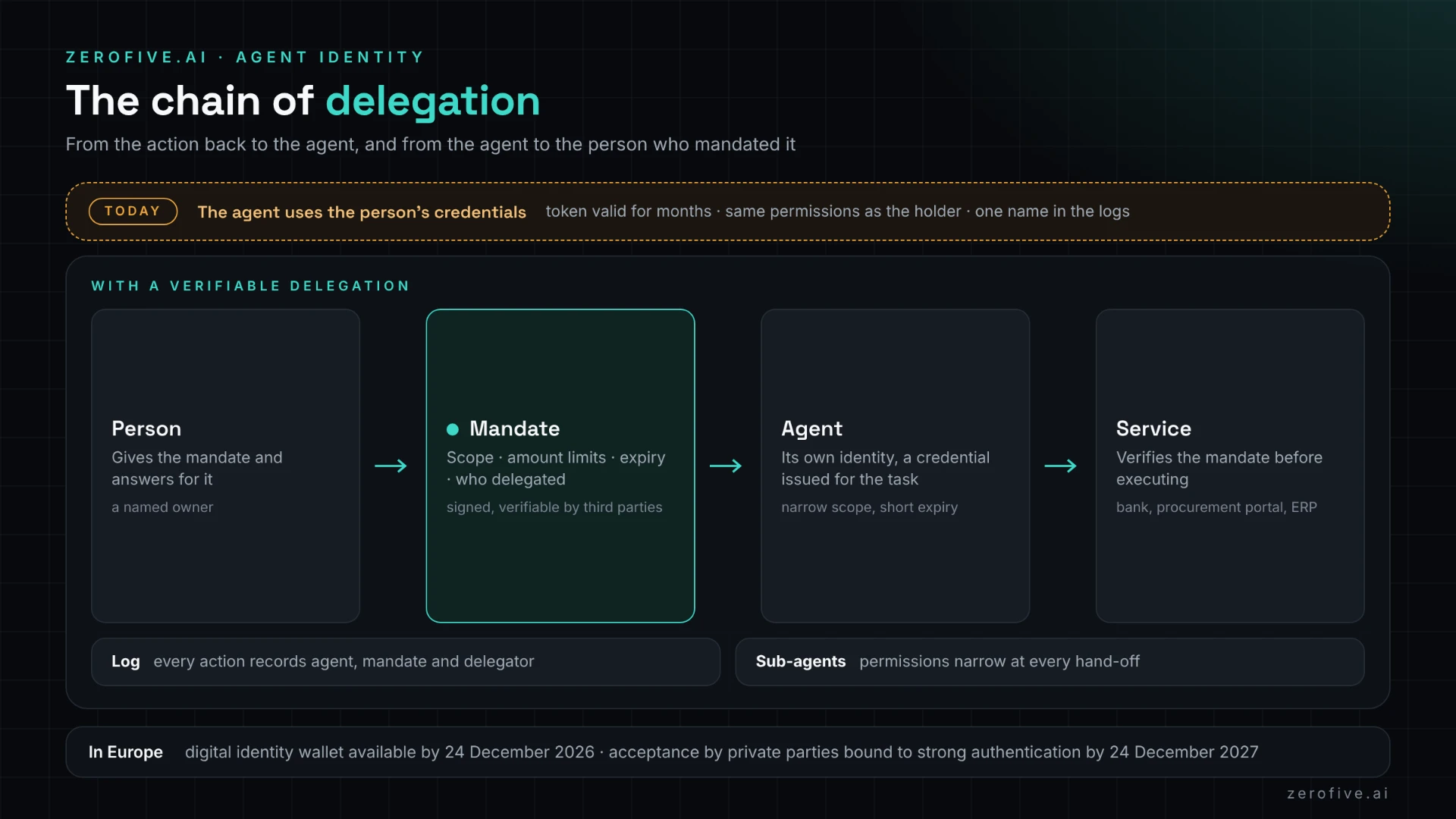
In short. Most AI agents in use authenticate with a person's credentials or with shared accounts, so systems cannot distinguish the agent's action from that of the person who delegated it. Standards are moving towards credentials issued for a task, with a narrow scope and a short expiry, accompanied by a verifiable mandate. The European digital identity wallet could give these delegations a public foundation. In the meantime the work is organisational: take a census of the agents, give them identities of their own and write down the delegation for each one.
The AI agents now entering companies read email, open tickets, update the CRM and in some cases send orders to a supplier. To do so they authenticate on the systems, and in the great majority of the installations we see they do it with the credentials of the person who configured them, or with a service account shared between several agents and created for the occasion.
From the point of view of the system receiving the request, in both cases it is impossible to distinguish the action performed by the person from the one performed by the agent in their place. The access log shows the same name, the same plausible time, the same permissions. Security teams treat this as a known risk, and those concerned with accountability usually discover it later, when they have to reconstruct who did what and on whose mandate.
Acting on someone's behalf
When a person uses an application, there is one identity. When an agent acts, at least two identities are in play, the agent's and that of the person or organisation on whose behalf it operates, and between the two there is a delegation with an object, a limit and a duration.
The protocols used today to manage access and authorisation were designed for the first case. The OpenID Foundation, the body that maintains the standard most online services use for authentication, published a paper on the subject on 7 October 2025, Identity Management for Agentic AI, which acknowledges that current tools cover simple agents operating within a single domain and leave uncovered those that cross several organisations, work asynchronously or have a high degree of autonomy.
Among the problems listed in the paper are some that a company meets very early. The agent that presents itself as if it were the user, without declaring that it is an agent. The delegation that passes from an agent to a sub-agent without permissions narrowing at each step. The fragmentation of identities, when every vendor builds its own system and the company ends up with as many registers as it has platforms.
Permanent credentials
The most widespread flaw concerns duration. A person who hands a task to a colleague gives them access to what that task needs, for the time it takes. An agent, by contrast, almost always receives a token that lasts for months and opens everything the person can open.
Standards are moving in the opposite direction. Credentials are issued for a specific task, with a narrow scope and a short expiry, and they carry an indication of who delegated. At the end of the task nothing is left to revoke, because the credential has already expired.
This is the same least-privilege principle that security officers have applied to human accounts for years, extended to an actor that works much faster and does not notice when it is doing something unusual.
The mandate as a document
Alongside the technical problem there is a legal one. If an agent concludes a purchase, accepts contractual terms or sends a communication to a customer, someone answers for it, and establishing who requires a trace of what had been authorised.
Civil law has always had a figure for this, the mandate. What is missing is its verifiable digital form: an object stating which person instructed which agent, to do what, up to what amount and until when, and which the receiving system can check before executing. Without that object the proof of delegation is a configuration inside a platform, which the vendor can modify and no third party can verify.
For a company this has immediate consequences for the organisational model. The second-generation AI policy that describes what a system may do without supervision needs a point where those limits are applied and recorded, and the agent's identity is that point. The same goes for the principle that no agent goes into production without a named owner: the owner's name has to appear in the delegation as well as in the organisation chart.
Which framework does your company actually need?
AI Rating measures maturity across the four areas of the model and shows where to start, with priorities and estimated effort.
Start your AI RatingEuropean digital identity and the wallet
Europe has an infrastructure that could give these delegations a public foundation. The eIDAS 2 regulation, Regulation (EU) 2024/1183, requires every Member State to make at least one digital identity wallet available by 24 December 2026, and in Italy the route runs through the IT-Wallet. By 24 December 2027 it will also have to be accepted, when the user asks for it, by private parties that are required by law or by contract to use strong authentication in sectors such as banking, energy, transport, health and telecommunications, with micro and small enterprises excluded, as set out in Article 5f.
The wallet was conceived for people and for businesses. It holds verifiable attributes, issued by authoritative sources, which the holder presents to whoever requests them, choosing what to show. Extending the same mechanism to delegation to an agent is a step the regulation does not explicitly provide for and that several working groups are exploring: the person signs a limited mandate with their wallet, the agent presents it to the service, and the service verifies it without needing to know the platform the agent runs on.
It is not yet a standard, and it is prudent to treat it as a direction. Anyone designing today how their agents access company systems would still do well to keep it in mind, because a year from now customers and suppliers will hold a tool for signing delegations, and the systems able to receive them will start with an advantage.
Agents that spend
The case that makes the matter urgent is payment. Card schemes and large platforms are publishing protocols that let an agent complete a purchase, and in the most discussed of them, the Agent Payments Protocol presented by Google in September 2025, the load-bearing element is a chain of signed mandates that proves what the user authorised and travels with the transaction.
Discussions among practitioners look further ahead, to very small agents buying individual services from other agents through micropayments. Today that prospect belongs more to research than to industrial plans. The question it raises, however, is already present in every company that has given an agent a virtual card or access to a purchasing portal: what spending limit it has, who set it, where it is written down.
The work that can be done now
While standards consolidate, most of the work is organisational and does not depend on any vendor.
- Take a census of the agents in use and, for each, the identity it presents to systems.
- Replace personal credentials with identities dedicated to the agent, distinguishable in the logs.
- Reduce the duration and scope of tokens, starting from the systems that hold personal data or move money.
- Write the delegation for every agent, with object, limits, expiry and the name of whoever granted it.
- Check that the logs make it possible to trace from the action to the agent and from the agent to the person.
The first item is often the hardest, because many agents were switched on by individual colleagues inside tools already purchased, and they appear in no inventory. That is why the register of AI systems should have, for agents, one more field for the identity they operate under.
In the AI Rating these checks fall under the Risk dimension, and they are among those that most often block the class even in technically advanced organisations, because a well-built agent acting under someone else's identity is a system whose control cannot be demonstrated. On the perimeter within which an agent may move, see the article on four layers and a delegation perimeter, and to check where your agents stand you can start an AI Rating or book an assessment meeting.