Connecting AI to company data: why you need an AI Company OS
Connecting ChatGPT or Claude to email, Drive and CRM is easy. Doing it without losing control of knowledge requires ontology, data classification and human approval.
In short. Connecting ChatGPT, Claude or Copilot to email, Drive and the CRM now takes a few minutes, and almost every company is trying it. The result, however, depends on how the knowledge the model reads is organised: without types and approval rules the assistant produces plausible answers whose origin nobody knows. An AI Company OS is the layer that brings order before the model, and decides which data goes to which AI and with which permissions.
Over the last year connectors have changed the way companies use generative AI. With the Model Context Protocol (MCP), the open standard Anthropic published in November 2024 and that OpenAI, Google and Microsoft adopted in the following months, an assistant can read an inbox, open a document, check a calendar or query a business application without anyone copying and pasting anything. The technical part, which until recently required an integration project, has become a setting to switch on.
This has moved the problem elsewhere, and many companies notice it after a few weeks of use.
Company knowledge is scattered across too many places
In almost every organisation a project's knowledge lives in seven or eight different places: meeting recordings, email, a folder on Drive and another on Dropbox, the calendar, the CRM, Slack or Teams channels, Jira or Asana tickets, personal notes. Each works well on its own, and none knows the others exist.
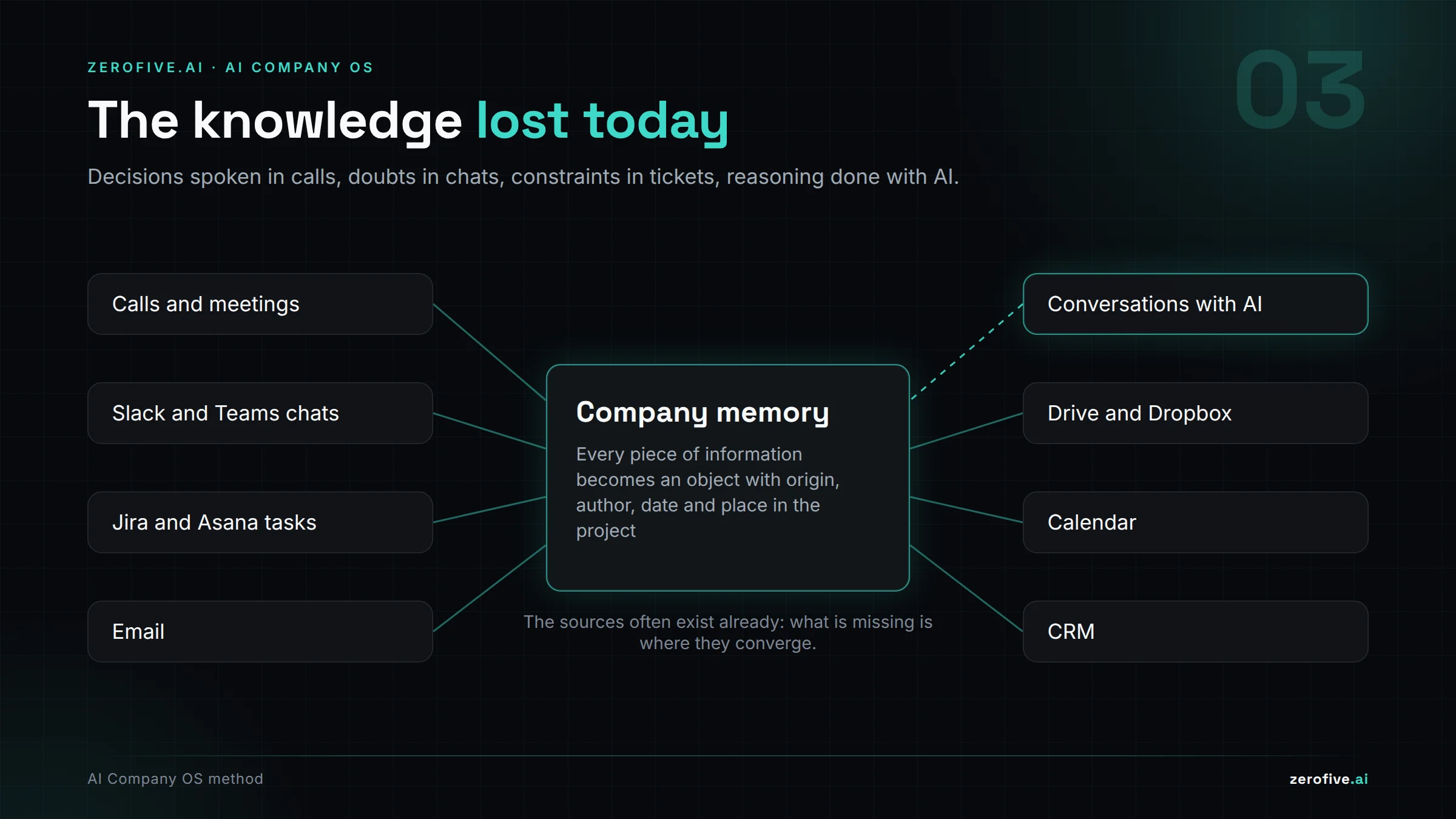
A new source has joined them that did not exist two years ago: the conversations each person has with their AI assistant while preparing a proposal or analysing a problem. That is often where the most useful reasoning of the day ends up, and it disappears when the window is closed, because no company system collects it.
What happens when an LLM reads everything
The most common reaction is to connect the model to every source and expect an overall view to emerge from the connection. Almost always the opposite happens. The model reconstructs the meaning of information on its own, slightly differently each time, and two answers to the same question a week apart do not match.
The typical cases are three. A client appears in the CRM with one decision maker and in meeting minutes with another, and the assistant picks one at random. A decision made in a call contradicts a document from a few days earlier, and the summary merges them as if they said the same thing. Confidential information, such as a margin or personal data, ends up in an answer read by someone who should not have seen it, because the connector used an account with access to everything.
None of these errors depends on the quality of the model. A more capable model produces more convincing answers from the same fragments, and makes the error harder to see.
What an AI Company OS is
We call AI Company OS the workspace where company knowledge becomes readable by models and governed by people. Every piece of information, a meeting note, a task, a document, a contact, becomes an object with a type, an author, a date and a place in the project. Models read it with the real permissions of whoever uses them, and nothing enters the shared memory unless a person has approved it.
The system is designed in six layers: centralisation, ontology, graph, connectors and models, skills, governance. The detail of the method and of the platform we use to build it is on the AI Company OS service page; here it is worth focusing on the three points that change the way people work the most.
Which framework does your company actually need?
AI Rating measures maturity across the four areas of the model and shows where to start, with priorities and estimated effort.
Start your AI RatingMeaning comes before data
Ontology is where a company decides what its information means, before a model decides for it. It establishes that a note does not weigh as much as a decision, that a risk calls for attention, that tags have a controlled vocabulary and three variants of the same name do not get created.
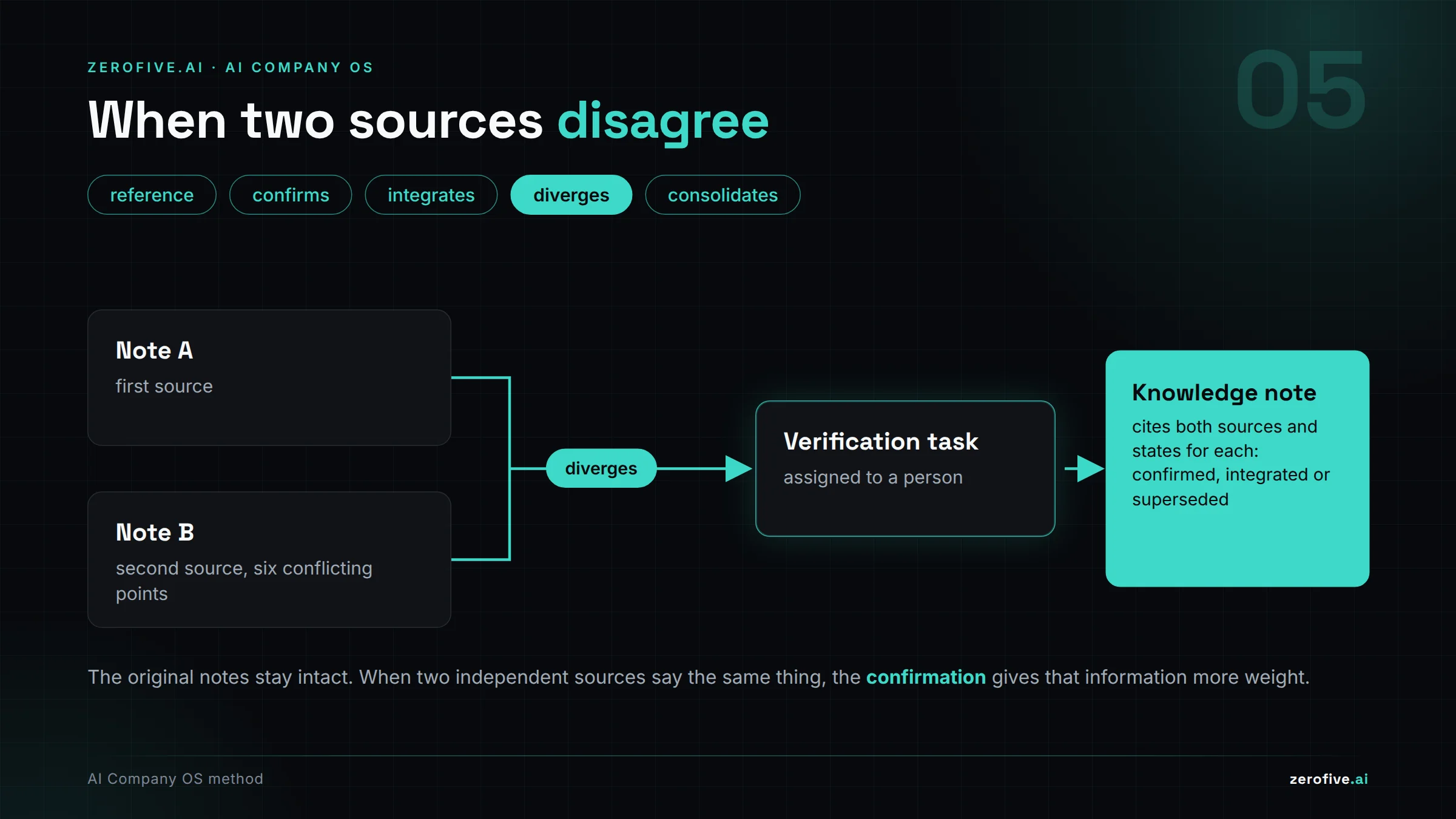
The most delicate part concerns contradictions. When two sources state different things on the same point, a naive system keeps the latest or merges them into a summary. In an AI Company OS the conflict becomes an explicit link, opens a verification assigned to a person and is closed with a note stating which source was confirmed and which superseded, leaving the originals intact.
Which AI for which data
If knowledge is structured, choosing the model becomes a decision about cost and confidentiality. The core of the system is an access server, today almost always an MCP server, independent of the model: the same server serves Claude, ChatGPT or an open model installed on a company machine, and always operates with the permissions of the person using it, never with an all-powerful technical account.
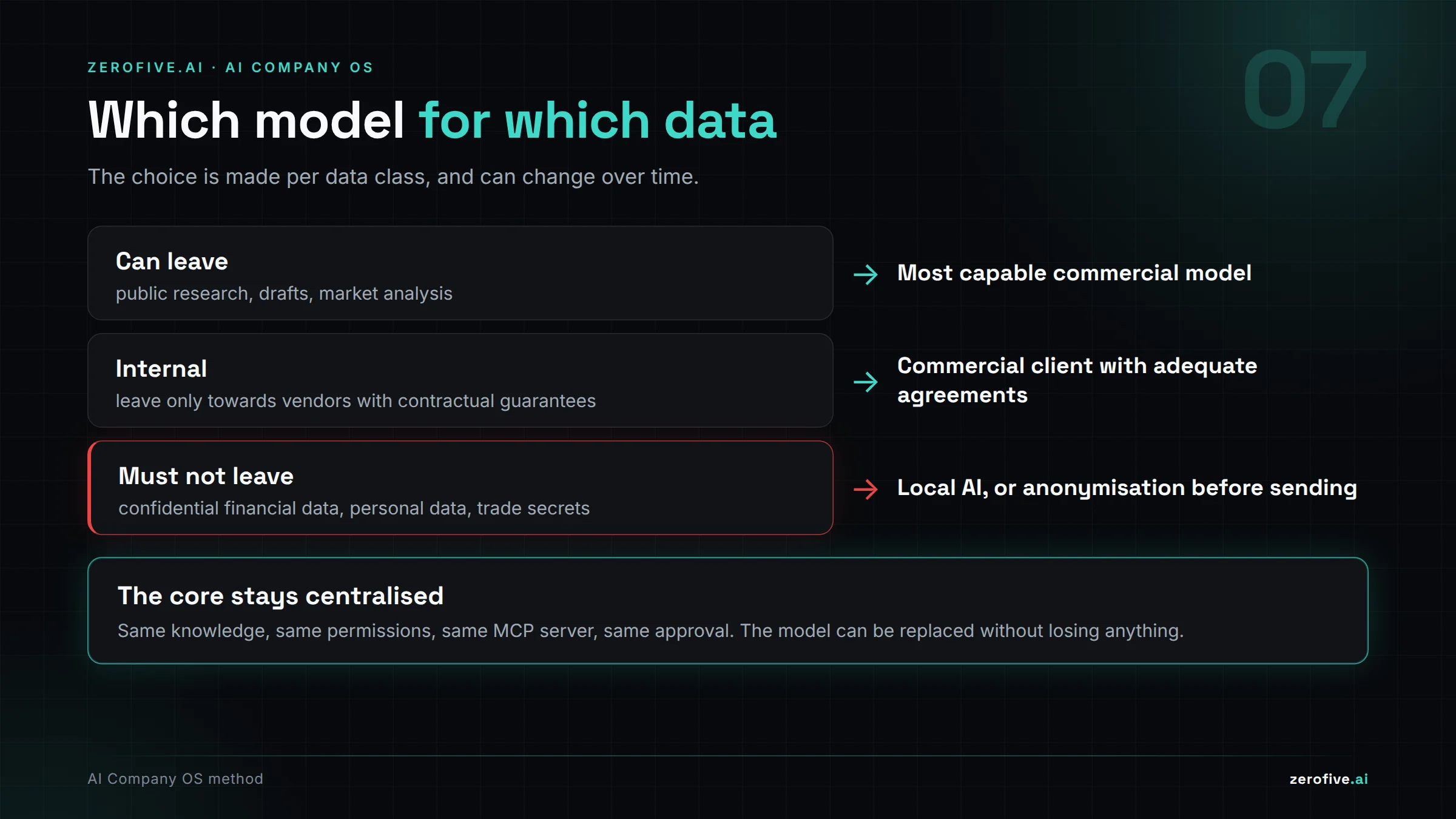
A practical way to decide is to classify information on three levels. What can leave, such as public research and drafts, goes to the most capable commercial model. Internal information goes only to vendors with adequate contractual guarantees. What must not leave, such as confidential financial data or personal data, stays on a local model or is anonymised before sending. Changing vendor, or using two side by side, requires no migration.
People's work changes
With an AI Company OS people enter less data and approve far more information prepared by the model. Meeting minutes arrive already written, with tasks extracted and linked to the right people, and the job of whoever receives them is to say whether they are correct. The model prepares proposals with the source, an excerpt and a confidence level, and when confidence is low it does not choose: the decision goes back to a person.
This rule also produces traceability, because every object has an origin and an owner. If six months from now someone asks why a decision was taken, the answer leads to a meeting, a person, a date, and it is the same kind of evidence an AI management system under ISO/IEC 42001 asks to be able to show.
Where to start
Anyone starting from scratch should begin on paper and leave the tools for later: an inventory of the information the team produces in a normal week, including what gets lost today in chats and AI conversations, and of the system that owns it. The technical part is often the fastest, because the sources already have their connectors. The long work is agreeing on what counts as a decision and on who can close a conflict.
We do it starting from a single team, with a method and a platform we built for ourselves first. If you want to understand how to apply it in your company, you can book a 30-minute inventory session or read how the AI Company OS service works.